







AI employees

AI cybersecurity engineer — runs locally.

The role that fixes: it inventories your machine, matches published advisories and applies the verified patch — with your approval, on your machine.

  • Runs on your machine
  • Approval before every fix
  • Your models, your keys
  • From €49/month

What it does

It keeps the machine current.

Inventory, advisory match, prepared fix, your approval, post-check. The same loop on every run.

The AI cybersecurity engineer holds the recurring security work of a small team: keep the inventory of the machine and repositories current, match published advisories against what is actually installed, prepare the fix for what is exposed, apply it with your approval and check the result. You delegate an outcome — this machine is patched, and the record shows it — not a prompt.

The engineer works alongside the analyst role. The analyst reads the exposure and explains it; the engineer prepares and applies the fix. Same licence, same machine, two specialisations.

What you get

What lands on your desk.

A fix that is applied and checked, plus the report that shows what changed.

Prioritised fixes for exposed services

When an exposed service runs a vulnerable version, the engineer prepares the fix and ranks it against everything else pending. The pattern is current: the PHP “php2shell” flaws — two unauthenticated remote code execution vulnerabilities (CVE-2026-109618 and CVE-2026-109619), fixed in PHP 8.5.12 / 8.4.27 / 8.3.36 / 8.2.35 — got a CISA alert on 21 October 2026 urging immediate patching. An exposed PHP service is exactly the kind of finding the engineer treats first.
Verified patches applied with your approval

The loop is the same every time: a reasoned proposal, a snapshot of the current state, the application with your approval, then a post-check that verifies the fixed version is actually running. The engineer never applies a change on its own — you set the autonomy level, and you can tighten it at any time.

A dated report

Each run ends with a timestamped local report: what was checked, what changed, what is pending. The same report answers an insurer questionnaire, a client security review, due diligence — and the Cyber Resilience Act documentation demands. The CRA's actively-exploited incident reporting obligations already apply since 11 September 2026, and its main obligations arrive on 11 December 2027: the inventory, the list of exposed versions and the fixes you approved are what that file asks for.

In the app

The finding before the fix.

The package, the advisory and the affected version, on one screen.

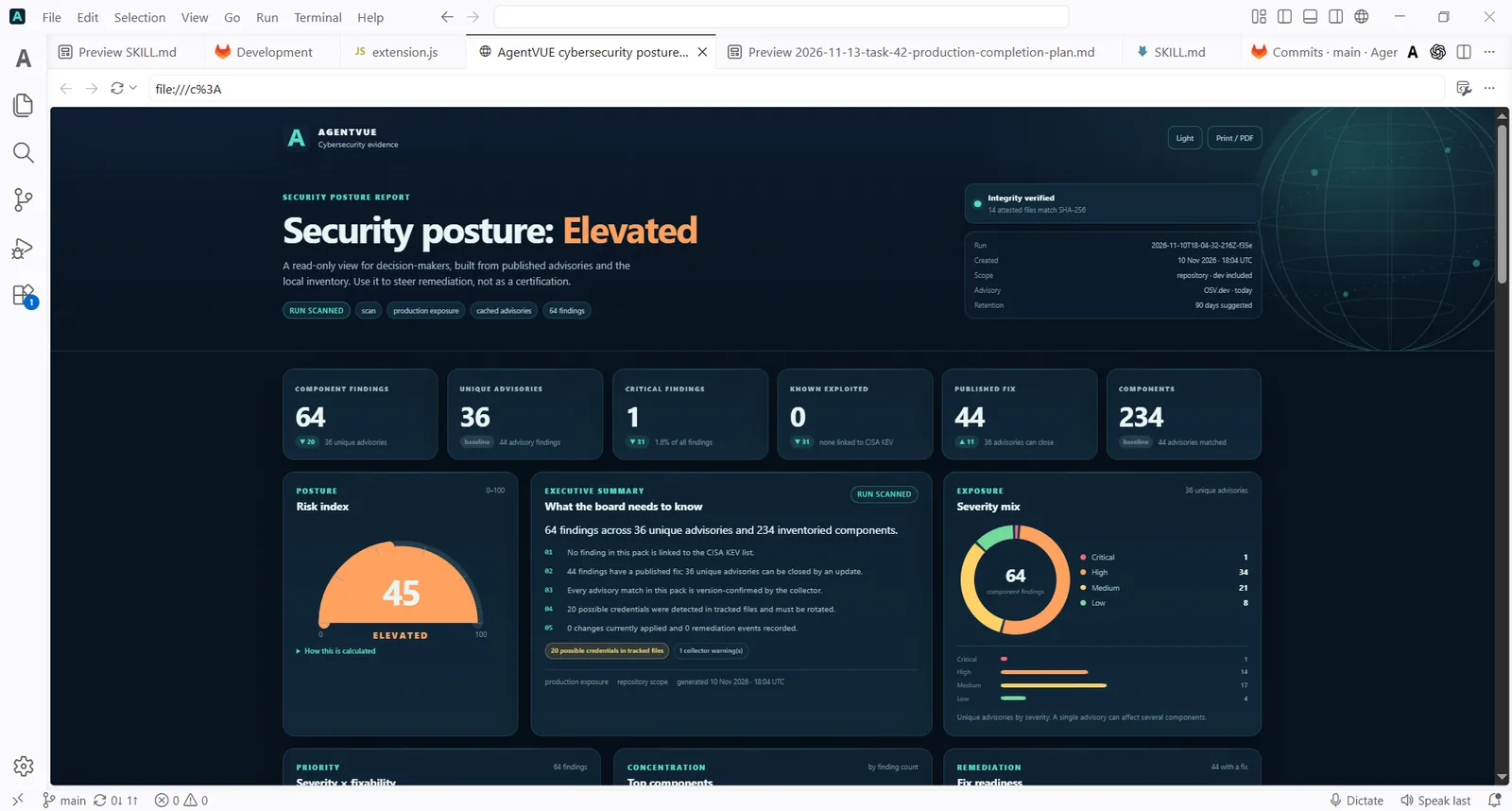
AgentVUE cybersecurity report showing 64 component findings across 36 advisories, a risk index of 45 and the severity mix.
Cyber engineer — security postureThe local security posture report before a fix is proposed.

How a run goes

Four steps. All on your machine.

The fix does not move until you approve it.

AI cybersecurity engineer — runs locally. — run

Inventory first

Installed packages, services, open ports, users, scheduled tasks, configuration drift and the dependency SBOM, collected on your machine. The agent works from facts on your disk, not from a guess.

Control

You approve the fix.

The engineer proposes, snapshots and asks.

Where you stay in control

The fix waits for you.

The engineer proposes the change, snapshots the state and asks. Nothing is applied while you are not looking.

Every fix waits for your approval.

Start here

Put the engineer to work this week.

Pick your plan, install, run the first pass. The first report arrives with the first inventory.

Built with AgentVUE

The workstation builds itself.

The same agents that run the role run AgentVUE. You are buying the machine that already does the work.

See the showcase
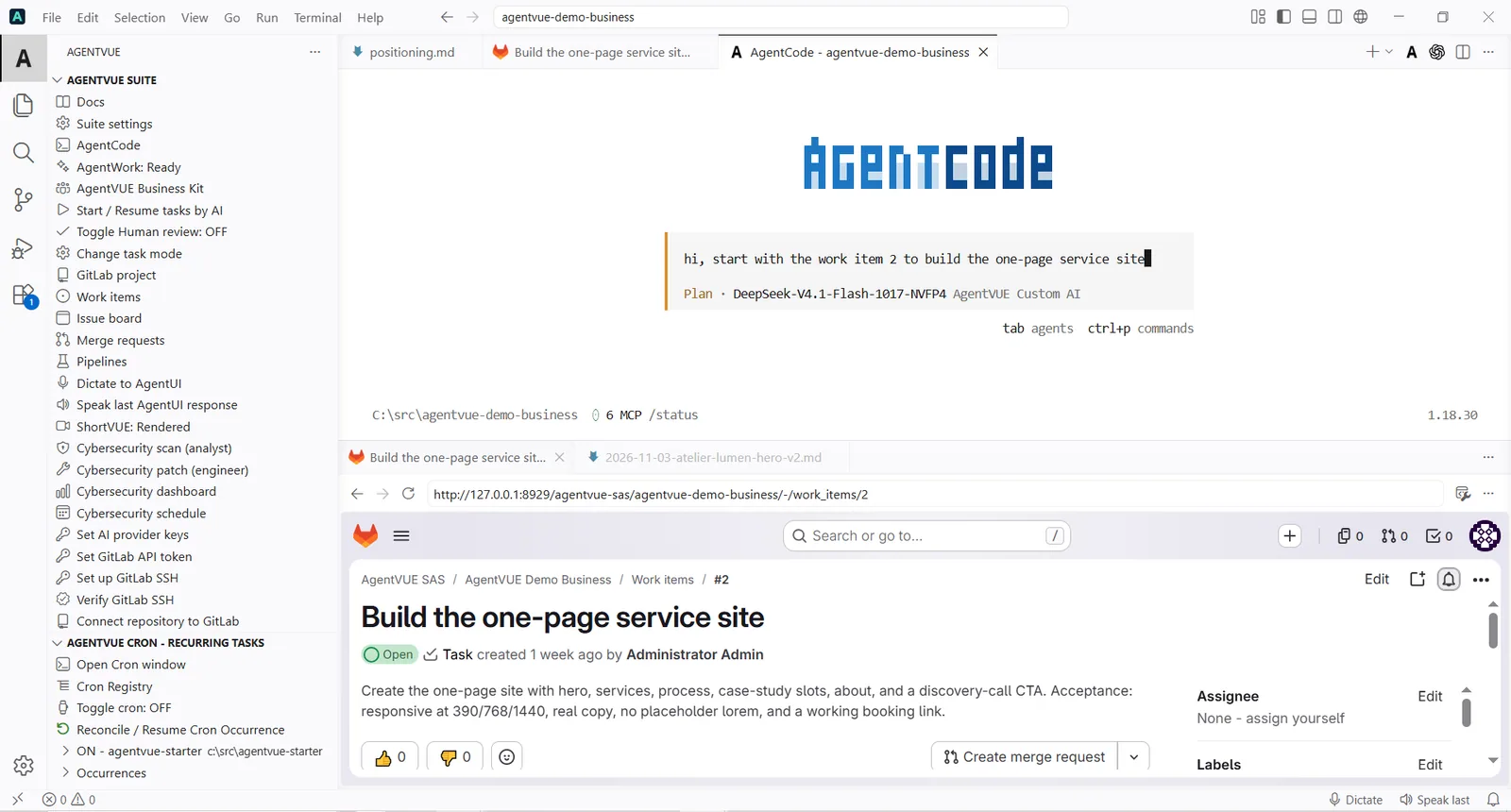
AgentCode showing a GitLab work item to build the one-page service site, the AgentVUE Suite sidebar and an open positioning.md draft.
AgentVUE builds AgentVUEAgentCode building the AgentVUE site from a GitLab work item, with the Business Kit in the sidebar.

Keep reading

The role in context — same licence, same machine.

Questions

AI cybersecurity engineer questions, answered

The checks, the approvals, the reports and the price.

Does the AI cybersecurity engineer apply patches automatically?

No. Every fix follows the same loop: reasoned proposal, snapshot, application with your approval, post-check. You decide how much autonomy the agent has, and you can change that at any time.

Which advisories does it work from?

Published ones, matched against what is actually installed on your machine: npm and PyPI advisories, vendor advisories, CISA alerts. The inventory comes first; the matching is done against your real versions, not a self-declared list.

What does it do with something urgent like the php2shell flaws?

It flags the exposed service, prepares the upgrade path to a fixed release — PHP 8.5.12 / 8.4.27 / 8.3.36 / 8.2.35 for the two php2shell flaws — applies it with your approval and verifies the result. The prioritisation is the point: an unauthenticated remote code execution on an exposed service goes first.

Where do the reports go?

On your machine. Each run ends with a dated local report you can export when you need it — for a client review, an insurer questionnaire or a CRA file. Nothing is uploaded anywhere by default.

Does it replace a security team?

It does the recurring engineering work: the checks, the matching, the prepared fixes, the post-checks. Judgement on incidents, architecture and risk acceptance stays with your people. Treat it as capacity, not headcount.

What does it cost?

One licence covers the whole workstation: Pro €49, Max €99, Ultra €199 per month billed yearly, or €33/€66/€123 per month with three years prepaid and one year free. The details are on the pricing page.

Next step

Start with the first inventory.

Pick your plan, install, run the first pass. The first dated report arrives with the first inventory.

Get AgentVUETour