How does the licence work?
You buy online and receive a signed licence file. The software runs offline: no activation server, no telemetry. The version you bought keeps working for good; updates are covered while your support window is open.
Do I get the source code?
The workstation is built on open-source components — the Code-OSS editor core, the AgentCode runtime and its MCP servers (MIT or Apache-2.0 depending on the component) — and ships as a local application you can inspect and script. The AgentVUE suite remains licensed software: Ultra grants internal modification, not redistribution.
Which AI models does it use?
Yours. AgentVUE talks to any OpenAI-compatible endpoint — a local model, your own server, or a provider you trust. Keys are stored in SecretStorage, never in a config file.
What can the agents actually do?
What a careful operator does on a computer: write and review code, run tests, drive a browser, generate images, video and music, manage Git issues and pipelines, and keep recurring tasks moving.
Is my code sent somewhere?
No. The work happens on your machine. The only outbound calls are the ones you configure: your AI endpoint, your media endpoints, your voice endpoints.
What about security?
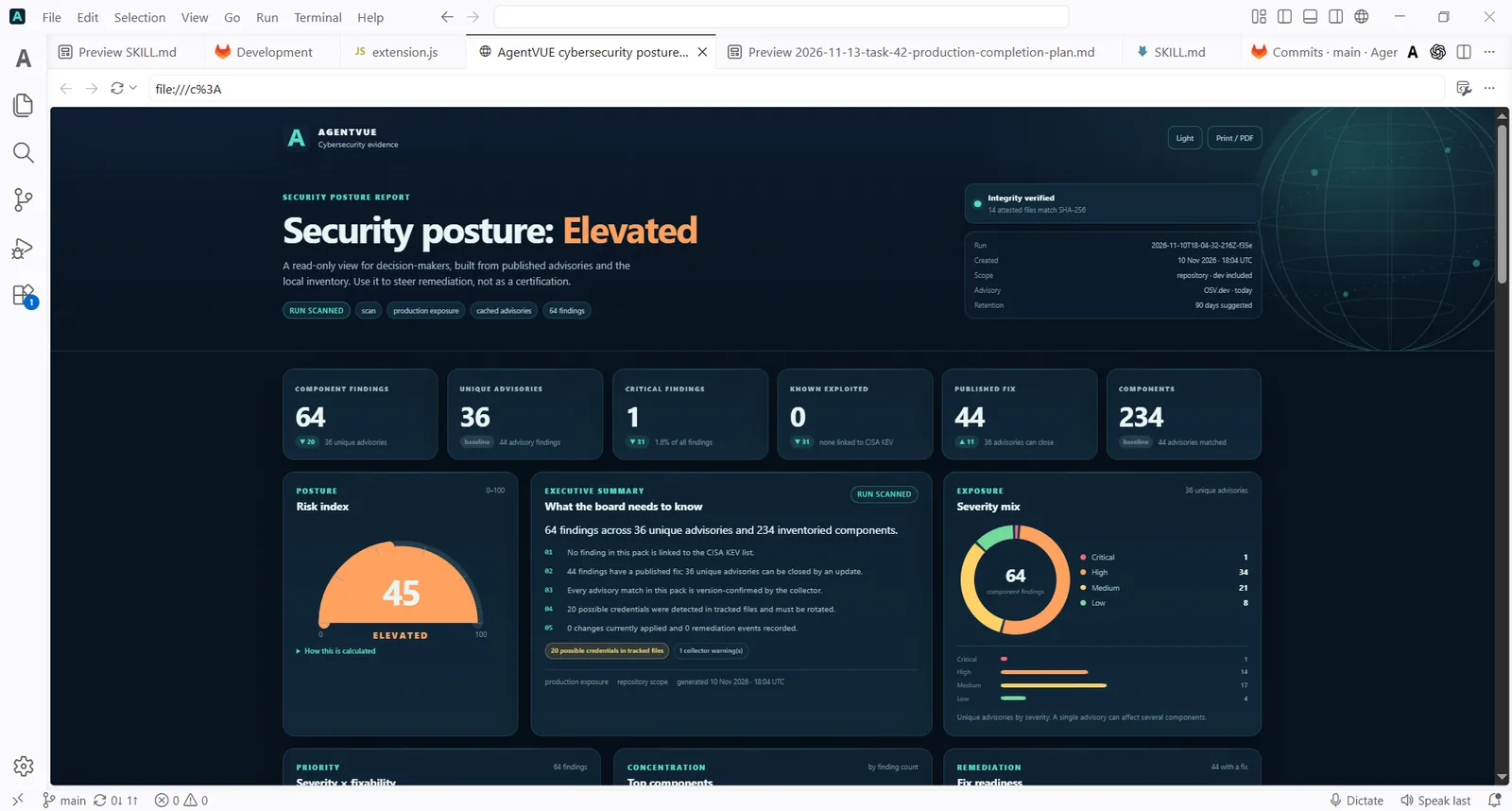
The cyber track inventories your machines and repositories, checks versions against published advisories and proposes the fix. Nothing is applied without a snapshot and your approval.
Can I sell what I create?
Max and Ultra, yes. Max covers commercial use inside your organisation, including selling the outputs you produce. Ultra adds white-label reports, agency/OEM delivery and internal modification of the software.
Is support a phone call?
No. Email or ticket, best effort, five business days. The product is built to be used without meetings.
Where does AgentVUE come from?
It began as one person's tool for running several projects without stitching five apps together. The local rigs came next, then the agents. The founder tells the whole story, including the risks that shaped the product, on benoit.ac.
Read the origin story on benoit.ac